Industrial solid waste management for Vietnamese SMEs: three groups, the paperwork, and the fines that actually land
Vietnam's law splits ordinary industrial solid waste into three groups; anything unsorted defaults to the costliest one. Duties, records and 2026 fines.
August 3, 2026 · 15 min read
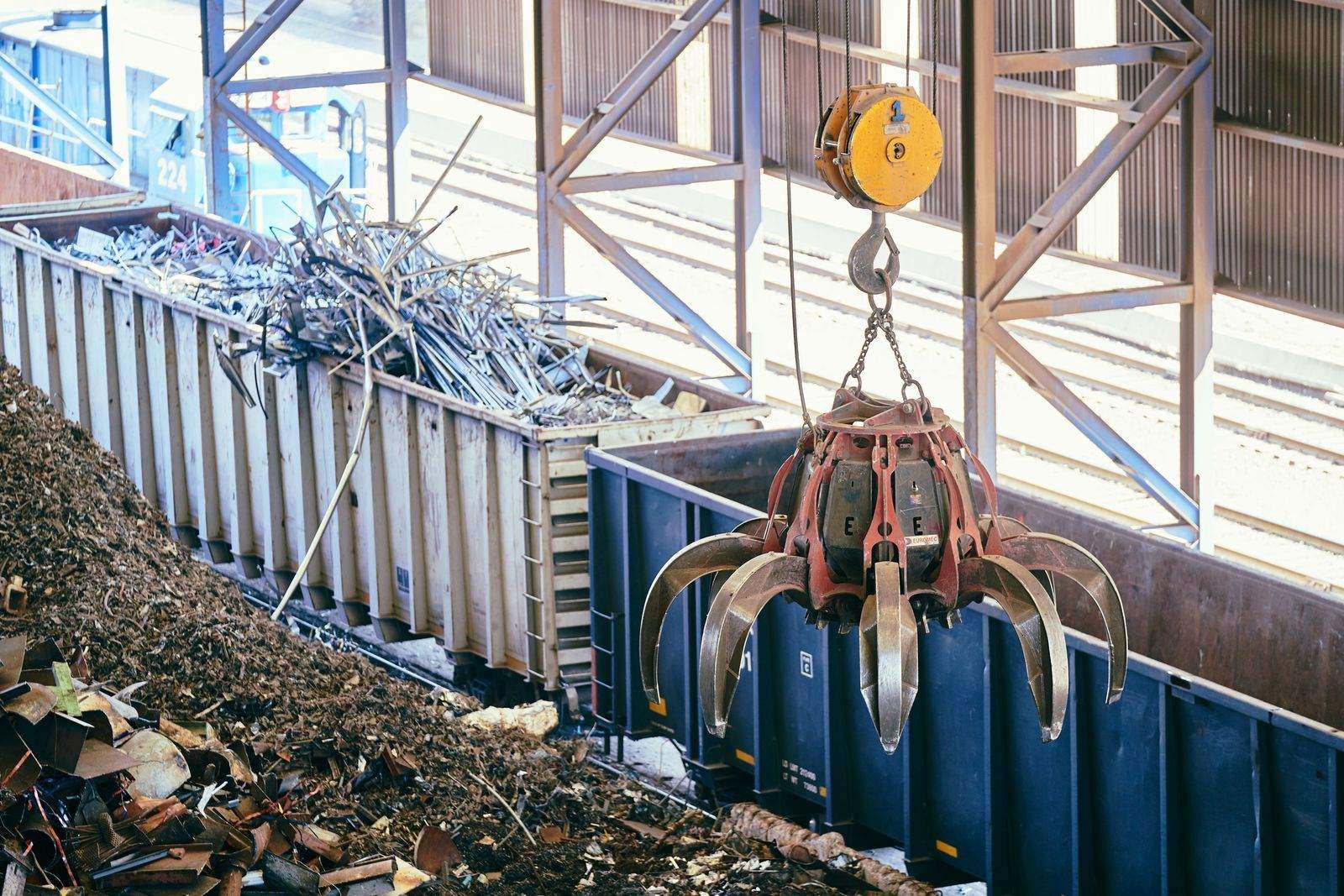
Photo: Willians Huerta / Pexels (free license)
Quick summary
Article 81 of Vietnam's Law on Environmental Protection splits ordinary industrial solid waste into three groups — material recycled as production input, material usable in construction materials and land levelling, and the group that must be treated — then adds a sentence most factories miss: anything not sorted must be managed as the group that must be treated. This article walks the full chain of generator duties: classification must rest on sampling and analysis by a qualified body rather than on visual judgement (Article 72.1(c)); waste may only be transferred to the four categories listed in Article 82; hazardous waste may be stored on site for no more than one year from generation (Article 71.1(c) of Decree 08/2022/ND-CP); and if the final copy of the manifest has not come back six months after transfer, the generator must report it. It sets out the concrete storage-area requirements in Circular 02/2022/TT-BTNMT — warning signs at least 30 cm on each side, liquid levels kept 10 cm below the container rim, only vessels above 2 m3 permitted outdoors, dry sand or sawdust and a shovel on hand for spills — alongside the penalty schedule in Decree 45/2022/ND-CP, with the reminder that every figure printed there applies to individuals and doubles for companies. Three currency warnings: Law 146/2025/QH15, effective 1 January 2026, amended Articles 81, 83 and 84 and repealed clauses 5 and 7 of Article 85; the annual environmental report is now due before 15 January rather than 5 January; and the Ministry of Natural Resources and Environment has become the Ministry of Agriculture and Environment, with reports going to the provincial department and the commune-level People's Committee. The article gives no unit price for hazardous waste treatment because no verifiable published price schedule exists.
Short answer: a factory's first duty for industrial solid waste is not hiring a truck — it is sorting at source. The law splits this waste into three groups and states plainly that whatever is not sorted must be managed as the group that must be treated: the most expensive and most tightly regulated of the three.
Last updated: 03/08/2026.
The short version for busy readers
Five things worth remembering, each citing the source text inside this article:
- Three groups, not two. Material reused or recycled as production input; material meeting standards for use in construction materials and land levelling; and material that must be treated.
- Not sorting means defaulting into the costliest group. That is the statutory wording, not an interpretation.
- Classification is laboratory work, not a supervisor's judgement call. The law requires hazardous-versus-ordinary determination through sampling and analysis by a qualified body.
- Sending waste to the wrong recipient is your breach, not your contractor's. For hazardous waste the recipient must hold a suitable environmental licence.
- Three legal reference points have just changed. An amending law took effect on 1 January 2026, the reporting deadline moved to 15 January, and the regulator's name is different.
Key figures — one verifiable source per line:
- Hazardous waste may be stored for no more than one year from generation; beyond that a written report is required (Decree 08/2022/ND-CP, consolidated text 49/VBHN-BNNMT of 17 April 2026, Article 71).
- Failing to sort ordinary industrial solid waste at source: VND 20–25 million for an individual, therefore VND 40–50 million for a company (Decree 45/2022/ND-CP, Article 26.2, Official Gazette 607+608).
- Transferring hazardous waste without a contract with a suitably licensed operator: VND 40–50 million for an individual, VND 80–100 million for a company (same source, Article 29.3).
- Vietnam generates roughly 23–25 million tonnes of ordinary industrial waste and about 800 thousand tonnes of hazardous waste a year, growing 10–12% annually (Ministry of Industry and Trade portal, 17 September 2025 — reported second-hand from a Ministry of Agriculture and Environment report we could not obtain in the original).
- Between 2022 and 2025 Vietnam recorded 14,863 administrative environmental violations carrying fines of more than VND 643 billion (Economy and Finance Review, 12 June 2026).
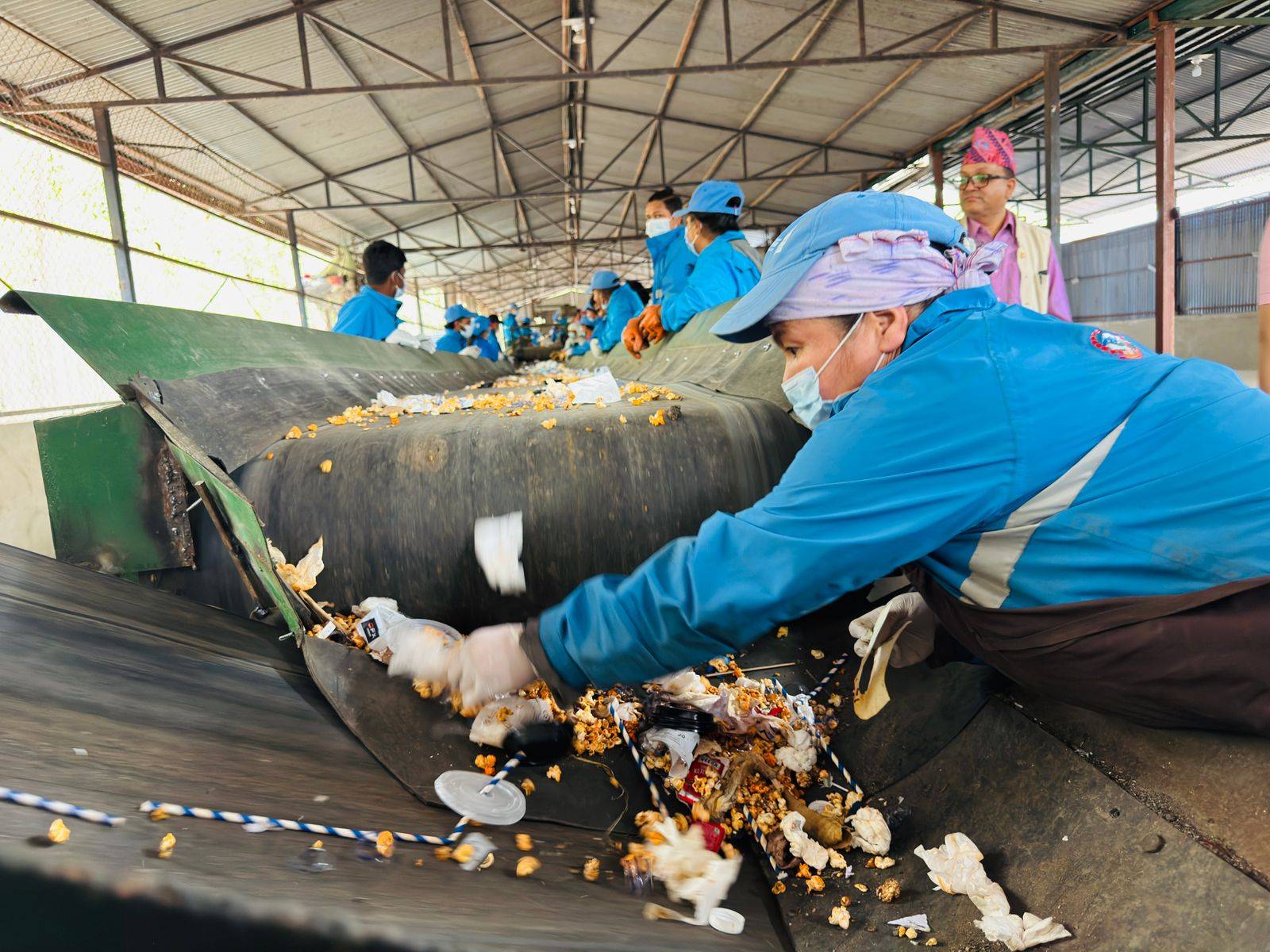
The three groups of ordinary industrial solid waste, and the trap in the third
Direct answer: the law does not ask what your waste is, it asks which group you have placed it in — and if you place it in none, the law places it in the least favourable one for you.
Article 81.1 of the Law on Environmental Protection, consolidated text 98/VBHN-VPQH of 10 April 2026, reads: "Ordinary industrial solid waste shall be classified into the following groups: (a) the group of ordinary industrial solid waste that is reused or recycled as production input; (b) the group of ordinary industrial solid waste that meets standards, technical regulations and technical guidance for use in the production of construction materials and land levelling; (c) the group of ordinary industrial solid waste that must be treated."
These are not merely administrative labels. They determine what you may do with the material, who may receive it, and whether you pay to dispose of it or are paid for it.
| Group | Statutory definition | What is permitted | Typical examples (illustrative) |
|---|---|---|---|
| a | Reused or recycled as production input | Transfer to producers using it directly as input; usually has market value | Scrap metal, cardboard, clean single-polymer plastics |
| b | Meets standards and technical regulations for construction materials and land levelling | Transfer to a lawfully operating construction-materials producer or levelling operation | Ash, slag, certain sludges meeting the technical regulation |
| c | Must be treated | Only to a treatment facility with matching function; each transfer needs a handover record | Inseparable mixed fractions, contaminated waste |
The single most important sentence sits in clause 2, and it operates automatically: "Ordinary industrial solid waste that is not classified must be managed as the waste specified in point (c) of clause 1 of this Article." If your plant tips everything into one bay, that entire tonnage — including the scrap you could have sold — is deemed to be the must-be-treated group. You lose the scrap revenue, carry the treatment cost, and owe a handover record for every load.
The second trap is in clause 3: "Ordinary industrial solid waste mixed with hazardous waste that is not classified or cannot be classified shall be managed in accordance with regulations on hazardous waste management." A bin of oily rags dropped into the paper waste does not just contaminate that bin — legally it can pull the whole consignment into the hazardous waste regime, which is far stricter and considerably more expensive.
Clause 4 closes with the operational requirement: "Ordinary industrial solid waste must be stored separately by the classified type; hazardous waste must not be mixed with ordinary industrial solid waste; dust must not be dispersed and wastewater must not leak into the environment." The phrase "stored separately by type" is why sorting at source cannot be implemented with a poster on the wall — it needs dedicated space, containers and labels per group.
Classification: eyeballing it is not a lawful method
Direct answer: deciding whether a waste stream is hazardous or ordinary must rest on sampling and analysis performed by a qualified body — a supervisor's experience is not a substitute for analytical results.
This is where many smaller factories go wrong in good faith. Article 72.1(c) provides: "The generator of industrial waste subject to control shall be responsible for determining whether the waste is hazardous waste or ordinary industrial solid waste through sampling and analysis carried out by a body with the requisite function and capacity in accordance with law. Industrial waste, once so determined, must be managed in accordance with law."
Determination and sorting are two different jobs, done in that order. Determination answers what is this and requires analytical evidence. Sorting is the act of separating and storing according to that answer. Skipping the first and jumping to the second leaves everything downstream built on sand — and the failure to determine is itself separately punishable, in the same VND 40–50 million band for individuals under Article 29.3(d) of Decree 45/2022/ND-CP.
There is an upside in the same article that gets little attention. Article 72.1(d) opens a route for material to leave the "waste" regime altogether: "Waste that meets the standards and technical regulations for raw materials, fuels and materials under the law on product and goods quality shall be managed as products and goods and may be used directly as raw material, fuel or material for production activities." This is the legal doorway for circular economy models: if your stream meets the technical regulation for a given input, it is no longer managed as waste. Proving that, however, still requires analytical data — which returns you to step one.
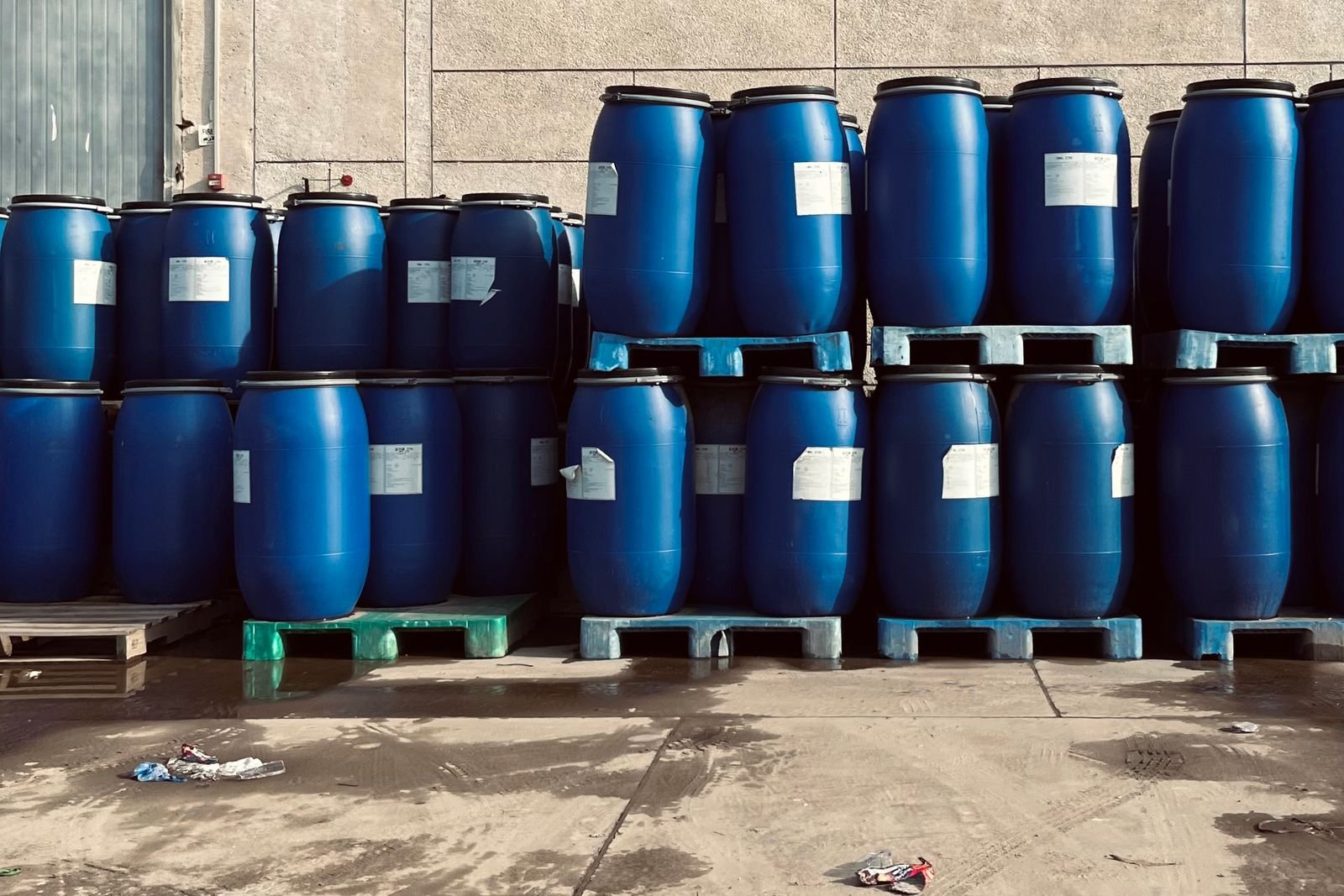
The hazardous waste store: the first thing an inspector looks at
Direct answer: a hazardous waste storage area need not be a purpose-built warehouse, but it must have a sealed floor, a roof, warning signage at least 30 cm on each side, and absorbent material ready for spills.
The technical requirements sit in Article 35 of Circular 02/2022/TT-BTNMT, consolidated text 55/VBHN-BNNMT. The text itself confirms the storage area "is not required to be built in the form of a warehouse", then lists a series of conditions: the floor must be sealed and impermeable and keep external rainwater from running in; the whole area must be roofed against sun and rain, except containers larger than 2 m3 which may stand outdoors; there must be measures to limit direct wind ingress; incompatible wastes that could react chemically must be segregated; and liquids must not run outside the area in the event of a leak or spill.
Three details are the most commonly failed at inspection, and each is a specific number. First, signage: the circular requires warning signs meeting the Vietnamese standard for hazardous waste warning symbols and "at least 30 cm on each side". Second, fill level: for liquids, sludges and volatile fractions, rigid packaging must not exceed 90% of capacity, or the highest fill level must sit "10 cm below the upper limit" of the container. Third, spill kit: the area must hold "absorbent material (such as dry sand or sawdust) and a shovel for use in the event of leakage, spillage or overflow of liquid hazardous waste", plus full fire-fighting equipment.
On top of that the Law adds a time limit that many facilities overlook. Article 83.2 states hazardous waste "may only be stored for a certain period as prescribed by law" — and the figure sits in Article 71.1(c) of Decree 08/2022/ND-CP: "Hazardous waste may only be stored for no more than 01 year from the time of generation. Where storage exceeds that period because no feasible transport or treatment option is available, or no suitable hazardous waste treatment service provider has been found, the generator must report annually on the storage of hazardous waste at the generating facility to the provincial specialised environmental authority."
The nuance matters: exceeding one year is not automatically a violation. The violation is exceeding one year without reporting, punishable at VND 5–10 million for individuals under Article 29.1 of Decree 45/2022/ND-CP. For a small plant generating a few dozen kilograms a year — not enough to make a specialised collection run economic — this is the lawful path: store to standard, and report.
Who may receive it, and the document to keep after every truck leaves
Direct answer: you may only transfer to the recipients the law lists, and verifying the recipient's status is your responsibility — their own assurance is not enough.
For ordinary industrial solid waste, Article 82.1 names exactly four eligible recipients: producers using it directly as input, for construction materials or for land levelling and "lawfully permitted to operate"; facilities with suitable co-processing function; ordinary industrial solid waste treatment facilities with matching function; and transporters that "have a transfer contract" with one of the first three. That fourth category is worth noting: a company that merely hauls is not sufficient — it must be able to show where the load ends up.
For hazardous waste the bar is markedly higher. Article 83.1(c) requires the generator to "transfer hazardous waste to a facility holding a suitable environmental licence for treatment", and Article 84.3(c) confirms that a hazardous waste treatment service provider must "hold an environmental licence". The practical vetting question is therefore short: show me the environmental licence, and point to the line covering my waste code. A licence that does not cover the exact code you are handing over is still a wrongful transfer.
| Duty | Ordinary industrial solid waste | Hazardous waste |
|---|---|---|
| Determination by sampling and analysis | Yes — to separate it from the hazardous stream | Yes — by code, catalogue and threshold |
| Maximum on-site storage period | No specific annual limit in the Law | One year from generation; beyond that, reporting required |
| Storage area requirements | Stored separately by type; no dust dispersal or leakage | Sealed floor, roof, segregation of reactive wastes, signage at least 30 cm, absorbent material |
| Document per transfer | Handover record (for the must-be-treated group) | Hazardous waste manifest — Form 04, Appendix III, Circular 02/2022 |
| Recipient eligibility | One of the four categories in Article 82.1 | Must hold an environmental licence matching the waste type |
| Post-transfer follow-up | Retain the handover record | If the final manifest copy has not returned after six months, report to the authority |
The last row is the most frequently missed obligation. Article 71.4 of Decree 08/2022/ND-CP provides: "After 06 months from the date of transferring hazardous waste, if the final copy of the hazardous waste manifest has not been received and no reasonable written explanation has been provided by the organisation or individual receiving the waste, the hazardous waste generator must report to the provincial specialised environmental authority or the Ministry of Agriculture and Environment for inspection and handling." Your responsibility does not end when the truck leaves the gate — it ends when the final copy of the manifest comes back. Failing to track this attracts VND 10–20 million for individuals.
Where material crosses a border, another layer applies. Article 83.5 of the Law itself refers to the Basel Convention on the control of transboundary movements of hazardous wastes, which sets the principle of "the restriction of transboundary movements of hazardous wastes except where it is perceived to be in accordance with the principles of environmentally sound management". If your supply chain has an export leg, review this alongside the data requests overseas customers are already making, as discussed in our piece on green supply chains.
Three legal reference points your internal documents may be citing wrongly
Direct answer: if your internal environmental procedure was written in 2022 and has not been reviewed since, it almost certainly misstates at least one of three things — the regulator's name, the reporting deadline, or a repealed provision.
First, the 2020 Law on Environmental Protection was amended by Law 146/2025/QH15 of 11 December 2025, in force from 1 January 2026. Checking each footnote in the consolidated text shows that within the waste chapter, Articles 81, 83 and 84 were all partly amended, two clauses of Article 85 were repealed, and only Article 82 survives untouched. Any procedure still citing "Article 85, clause 5" or "clause 7" is citing provisions that no longer exist.
| Provision / item | Change | Amending instrument | Effective |
|---|---|---|---|
| Law — Article 81.5(c) | Amended: transport routes and hours set by the provincial People's Committee | Law 146/2025/QH15 | 01/01/2026 |
| Law — Article 83.3 | Amended: rules on transporting hazardous waste | Law 146/2025/QH15 | 01/01/2026 |
| Law — Article 84.3 and 84.4 | Amended: conditions for treatment facilities and authority to issue technology criteria | Law 146/2025/QH15 | 01/01/2026 |
| Law — Article 85.5 and 85.7 | Repealed | Law 146/2025/QH15 | 01/01/2026 |
| "Ministry of Natural Resources and Environment" | Replaced by "Ministry of Agriculture and Environment" | Law 146/2025/QH15 | 01/01/2026 |
| Decree 08/2022/ND-CP | Amended three times: 05/2025, 48/2026 and 110/2026 | Decree 110/2026/ND-CP | 25/5/2026 |
| Circular 02/2022/TT-BTNMT | Amended four times, most recently by Circular 22/2026/TT-BNNMT | Circular 22/2026/TT-BNNMT | 19/5/2026 |
| Annual environmental report deadline | Moved from 5 January to before 15 January | Circular 07/2025/TT-BTNMT | 28/02/2025 |
| Report recipients | Provincial Department of Agriculture and Environment + commune-level People's Committee (district level abolished) | Circular 09/2026/TT-BNNMT | 29/01/2026 |
Second, the reporting deadline. Article 66.2 of Circular 02/2022 in its current form requires production, business and service facilities to report annually, with the "reporting period running from 01 January to the end of 31 December", submitted "before 15 January of the following year"; industrial park and cluster infrastructure operators have until 20 January. The 15 January date replaced the earlier one with effect from 28 February 2025 — any document still showing 5 January is out of date. Failing to prepare or submit the report carries VND 5–10 million for individuals, therefore VND 10–20 million for companies, under Article 43.1 of Decree 45/2022/ND-CP.
Third, good news for the smallest operators: Article 66.1(b) states that "entities exempt from environmental registration under Article 32 of Decree 08/2022/ND-CP are not required to prepare an environmental protection report". Before investing effort in the report, check whether your facility falls within the exemption — the same document-review logic our article on water and industrial wastewater works through.
The penalty schedule and the doubling rule everyone forgets
Direct answer: every fine printed in Decree 45/2022/ND-CP applies to individuals. Companies pay double — so read every penalty table you find online with a factor of two.
The rule is in Article 6.2: "The fine levels for administrative violations specified in Chapter II of this Decree are the fine levels applicable to administrative violations committed by individuals. For organisations committing the same violation, the fine level shall be 02 times the fine level applicable to individuals." A great many Vietnamese-language articles reproduce the penalty tables while dropping this sentence, leaving companies to estimate their exposure at half its real size.
| Conduct | Provision | Individual | Company (×2) |
|---|---|---|---|
| No handover record for must-be-treated industrial solid waste, per transfer | Art 26.2(a) | VND 3–5m | VND 6–10m |
| No sorting at source; non-compliant containers or storage area; no contract with a functionally qualified operator | Art 26.2(b) | VND 20–25m | VND 40–50m |
| Not storing sorted waste separately by type; no store or storage area at all | Art 26.2(c) | VND 25–30m | VND 50–60m |
| Storing hazardous waste beyond one year without reporting | Art 29.1 | VND 5–10m | VND 10–20m |
| Not retaining and managing hazardous waste manifests and related records | Art 29.2(a) | VND 10–20m | VND 20–40m |
| No contract with a suitably licensed operator before transferring hazardous waste | Art 29.3(a) | VND 40–50m | VND 80–100m |
| Not determining hazardous waste by code, catalogue and threshold; non-compliant storage area | Art 29.3(d), (e) | VND 40–50m | VND 80–100m |
| Selling or giving hazardous waste to an unqualified party, under 100 kg | Art 29.5(a) | VND 10–40m | VND 20–80m |
| Failing to prepare or submit the environmental protection report | Art 43.1 | VND 5–10m | VND 10–20m |
The scale for selling hazardous waste to the wrong party climbs steeply with volume: from VND 10–40 million below 100 kg to VND 220–250 million at 5,000 kg or more, and VND 500 million to 1 billion where the waste contains persistent organic pollutants listed in Annex A to the Stockholm Convention — doubled again for companies. Which is why "someone offered to buy it and the price seemed fine" is a poor financial decision.
The odds of being inspected are also higher than many assume. According to a summary published on 12 June 2026, between 2022 and 2025 the Ministry of Agriculture and Environment inspected 1,074 facilities and fined 348 of them a total of more than VND 96.67 billion, with "the rate of facilities found in violation through inspection reaching 42%, up 8% on the previous period". For every two facilities inspected, roughly one was found in breach.
From a cost line to a saleable material stream
Direct answer: sorting properly is one of the rare measures that cuts legal risk and creates revenue at the same time, because groups (a) and (b) have commercial outlets while group (c) is something you pay to remove.
The volumes involved are not small. The Ministry of Industry and Trade portal, citing a Ministry of Agriculture and Environment report, states that Vietnam generates "about 23–25 million tonnes of ordinary industrial waste and about 800 thousand tonnes of hazardous waste" a year, growing 10–12% annually, with the South-East region alone accounting for nearly 60% of the total. That figure is reported second-hand — we could not obtain the underlying ministry report, and say so plainly so readers can weigh it accordingly.
One example with primary data shows how far moving a stream from group (c) to group (b) can go: coal-fired power station ash and slag. According to the National State of the Environment Report 2016–2020, about 17 million tonnes of ash and slag arose in 2020 and "consumption of ash and slag reached about 10.5 million tonnes, accounting for 62% of total arisings (compared with about 39.5% in 2018 and 50% in 2019)". From 39.5% to 62% in two years, largely because ash and slag were recognised as input for construction materials and levelling — precisely group (b) of Article 81.
It is also worth being candid about Vietnamese data quality. The same report records that "the collection and treatment rate for industrial solid waste is fairly high, reaching over 90% of arisings" for 2016–2020, while the 2025 Ministry of Industry and Trade piece cites "about 70% of industrial waste being collected and treated". The two figures do not reconcile and were compiled on different bases; we quote both with their years rather than picking the more flattering one. The same applies to costs: no published price schedule exists for hazardous waste treatment — prices are set contract by contract or through tender — so this article gives no figure per kilogram.
Set against international practice, the order of priority is the same. The European Commission summarises the spirit of the Waste Framework Directive in one line: "Preventing waste is the preferred option, and sending waste to landfill should be the last resort" (European Commission). But the EU is no absolute model: per Eurostat, in 2022 the EU recovered "more than a half (61.4%) of the waste", yet for hazardous waste only "36.4% of the hazardous waste treated in the EU was recovered". Even where infrastructure is strongest, the hazardous stream remains the hard one. For Vietnamese SMEs the sensible goal is not to recycle everything but to separate well enough that the saleable share is sold and the treated share shrinks — the same direction as the packaging recycling duties analysed in our article on EPR.
Talking about waste without greenwashing
Direct answer: you may state three things — what quantity, measured over what period, and transferred to whom. Anything beyond that needs data attached.
Waste invites overstatement, because the numbers always sound encouraging. The three most common errors:
- Jumping from "sorted" to "zero impact". Sorting to the standard is legal compliance, not an environmental achievement. Do not turn obeying the law into a sustainability slogan.
- Jumping from "transferred" to "recycled". All you know for certain is that the waste went to a qualified operator; the final treatment outcome is theirs. Only claim recycling if you hold a manifest or specific confirmation from the treatment provider.
- Quoting a percentage without the denominator. "Waste down 40%" is meaningless without the base year, whether it is measured on total tonnage or per unit of output, and whether the hazardous stream is included.
A safe formulation that still carries weight names the scope, the measurement period and the confirming party. For example: "In 2025, plant X generated [figure] tonnes of ordinary industrial solid waste, of which [figure] tonnes fell in the recycled-as-input group and were transferred to [operator] under handover records; [figure] kg of hazardous waste were transferred to [operator] holding environmental licence no. [number]." That sentence is verifiable, and because it is verifiable it carries weight with banks and export customers alike. The general principles for any environmental claim are covered in our article on green labels and anti-greenwashing.
What to do in the next 90 days
Direct answer: four tasks, in this order, and the first one costs nothing.
- List your waste streams before buying a single bin. Walk the plant and write down each stream: where it arises, roughly how much per month, and where it currently goes. Most facilities have never had this list, and without it grouping is impossible.
- Have the doubtful streams determined. For anything potentially hazardous — oily rags, spent solvents, chemical packaging, sludges, failed electronics — commission sampling and analysis by a qualified body. The determination result underpins everything downstream, and its absence is itself a punishable breach.
- Vet your contractor with one question. Ask for a copy of the environmental licence and have them point to the line covering your waste code. At the same time, check your own records: over the last six months, is there any hazardous waste transfer whose final manifest copy never came back? If so, deal with it now.
- Put 15 January in the calendar, not in your memory. The environmental protection report for the 1 January to 31 December period is due before 15 January of the following year, submitted to the licensing authority, the provincial Department of Agriculture and Environment and the commune-level People's Committee. Check whether your facility uses Form 05.A or 05.B, depending on whether it holds an environmental licence or an environmental registration.
To go further, the sensible sequence is to standardise the waste documentation first, and only then consider capital-intensive steps such as changing technology or seeking incentives under the green taxonomy. A clean waste file is exactly what banks, customers and inspectors all ask for — they simply ask in different words.
For industrial solid waste, a Vietnamese company's legal obligation begins not at treatment but at sorting at source: the law places anything unsorted into the must-be-treated group by default, so a factory that skips this step forfeits the scrap revenue it could have earned, carries a higher treatment cost, and faces a penalty schedule that doubles for organisations.
Frequently asked questions
Are small companies required to sort industrial solid waste?
Yes. Article 81.2 of the Law on Environmental Protection places the duty to sort at source on any production, business or service facility generating ordinary industrial solid waste, regardless of size, and provides that anything not sorted must be managed as the must-be-treated group. Failure to sort at source carries VND 20–25 million for individuals, therefore VND 40–50 million for companies, under Article 26.2(b) of Decree 45/2022/ND-CP.
How long may hazardous waste be stored on site?
No more than one year from the time of generation, under Article 71.1(c) of Decree 08/2022/ND-CP. If that period is exceeded because no feasible transport or treatment option exists, or no suitable treatment provider has been found, the generator must report annually to the provincial specialised environmental authority. Exceeding the period without reporting carries VND 5–10 million for individuals and VND 10–20 million for companies.
How do I know a company is qualified to receive my hazardous waste?
Ask for its environmental licence and check that it covers hazardous waste treatment services matching the waste you are transferring. Article 84.3(c) of the Law on Environmental Protection requires hazardous waste treatment service providers to hold an environmental licence. Transferring without a contract with a suitably licensed operator carries VND 40–50 million for individuals and VND 80–100 million for companies.
What is a hazardous waste manifest and how must it be kept?
It is the document made on Form 04, Appendix III to Circular 02/2022/TT-BTNMT, prepared by the generator together with the treatment service provider at the point of transfer. The generator must retain and manage used manifests and related records; in addition, if the final copy has not been received six months after transfer, the generator must report to the authority for inspection. Failing to retain and manage manifests carries VND 10–20 million for individuals and VND 20–40 million for companies.
When is the annual environmental protection report due?
Before 15 January of the following year for project owners and production, business and service facilities; before 20 January for operators of industrial park and cluster infrastructure. The reporting period runs from 1 January to 31 December. The 15 January date has applied since 28 February 2025 under Circular 07/2025/TT-BTNMT — any document still stating 5 January is out of date.
Can a factory treat its own industrial solid waste?
Yes, but all three conditions in Article 82.4 of the Law on Environmental Protection must be met: it must be done using technology, environmental protection works and equipment already on the facility's premises and meet environmental protection requirements; it must be consistent with the approved environmental impact assessment decision or environmental licence; and no new incinerator or landfill may be built for the purpose, except where consistent with relevant planning. Self-treatment failing environmental requirements carries VND 30–50 million for individuals and VND 60–100 million for companies.
References
- Luật Bảo vệ môi trường — văn bản hợp nhất số 98/VBHN-VPQH ngày 10/4/2026, Công báo số 254 ngày 28/4/2026 (Điều 72, 81, 82, 83, 84, 85)
- Nghị định số 08/2022/NĐ-CP quy định chi tiết một số điều của Luật Bảo vệ môi trường — văn bản hợp nhất số 49/VBHN-BNNMT ngày 17/4/2026 (Điều 66, 68, 69, 70, 71)
- Thông tư số 02/2022/TT-BTNMT quy định chi tiết thi hành một số điều của Luật Bảo vệ môi trường — văn bản hợp nhất số 55/VBHN-BNNMT (Điều 35 yêu cầu kỹ thuật lưu giữ và chứng từ chất thải nguy hại, Điều 66 báo cáo công tác bảo vệ môi trường)
- Nghị định số 45/2022/NĐ-CP ngày 07/7/2022 về xử phạt vi phạm hành chính trong lĩnh vực bảo vệ môi trường — Công báo số 607+608 ngày 21/7/2022 (Điều 26, Điều 29, Điều 43)
- Nghị định số 45/2022/NĐ-CP — Công báo số 605+606 ngày 21/7/2022 (Điều 6: mức phạt với tổ chức gấp 02 lần cá nhân)
- Nghị định số 48/2026/NĐ-CP ngày 29/01/2026 sửa đổi, bổ sung một số điều của Nghị định số 08/2022/NĐ-CP — Công báo Chính phủ
- Báo cáo hiện trạng môi trường quốc gia giai đoạn 2016–2020 — Bộ Tài nguyên và Môi trường, NXB Dân Trí 2021 (phát sinh chất thải rắn công nghiệp, chất thải nguy hại, tro xỉ nhiệt điện than)
- Công nghiệp tái chế: trụ cột mới cho tăng trưởng xanh và kinh tế tuần hoàn — Cổng thông tin điện tử Bộ Công Thương, 17/9/2025 (số liệu 23–25 triệu tấn, dẫn lại báo cáo Bộ Nông nghiệp và Môi trường)
- Gần 15.000 vụ vi phạm môi trường bị phát hiện, xử lý giai đoạn 2022–2025 — Tạp chí Kinh tế – Tài chính, 12/6/2026
- Waste Framework Directive — European Commission (nguyên tắc thứ bậc quản lý chất thải)
- Waste statistics — Eurostat, dữ liệu năm 2022 (tỷ lệ thu hồi chất thải và chất thải nguy hại tại EU)
- Basel Convention on the Control of Transboundary Movements of Hazardous Wastes and their Disposal — Overview